

A Court of Splintered Harmony: The Valkyrie Cycle, Movement I (A Court of Thorns and Roses, 6)
$22.40 (as of September 19, 2026 07:39 GMT +00:00 – More infoProduct prices and availability are accurate as of the date/time indicated and are subject to change. Any price and availability information displayed on [relevant Amazon Site(s), as applicable] at the time of purchase will apply to the purchase of this product.)
Theo of Golden: A Novel
$12.99 (as of September 19, 2026 07:39 GMT +00:00 – More infoProduct prices and availability are accurate as of the date/time indicated and are subject to change. Any price and availability information displayed on [relevant Amazon Site(s), as applicable] at the time of purchase will apply to the purchase of this product.)
Scholastic Flash Cards: Sight Words
$3.07 (as of September 19, 2026 07:39 GMT +00:00 – More infoProduct prices and availability are accurate as of the date/time indicated and are subject to change. Any price and availability information displayed on [relevant Amazon Site(s), as applicable] at the time of purchase will apply to the purchase of this product.)
Whistler: A Novel
$14.99 (as of September 19, 2026 07:39 GMT +00:00 – More infoProduct prices and availability are accurate as of the date/time indicated and are subject to change. Any price and availability information displayed on [relevant Amazon Site(s), as applicable] at the time of purchase will apply to the purchase of this product.)
The Counterrevolution: The Fall and Rise of Donald Trump and the MAGA Movement
$29.82 (as of September 19, 2026 07:39 GMT +00:00 – More infoProduct prices and availability are accurate as of the date/time indicated and are subject to change. Any price and availability information displayed on [relevant Amazon Site(s), as applicable] at the time of purchase will apply to the purchase of this product.)Over the years, you may have pondered the best approach to launching your startup: relying on your skills or seeking external investment. This post will guide you through a detailed comparison of skills-based and investment-based models, exploring the capital required and the learning curves involved in each. Understanding these differences will empower you to make informed decisions that align with your resources, capabilities, and entrepreneurial aspirations.
Key Takeaways:
- Skills-based capital focuses on leveraging personal expertise, experience, and competencies to drive business success.
- Investment-based capital relies on external funding sources, such as investors or loans, to finance startup operations and growth.
- Skills-based startups often require less initial financial investment, reducing risk associated with debt and equity financing.
- Investment-based models may offer quicker scalability and immediate resources, but come with higher accountability and expectations from investors.
- Both models have distinct learning requirements; skills-based often emphasizes continuous self-improvement, while investment-based focuses on financial acumen and operational management.
The Foundations of Startup Capital
Understanding the core of startup capital involves differentiating between skills-based and investment-based resources. Your ability to leverage both types significantly influences the trajectory of your venture. Skills-based capital focuses on leveraging human capital, while investment-based capital centers on financial backing. Each type presents unique advantages and challenges depending on your entrepreneurial strategy.
Defining Skills-Based Capital: Assets Beyond Money
Skills-based capital refers to the unique talents, experiences, and relationships that you can bring to your startup. This encompasses your expertise, the skills of your team, and your network connections, all of which contribute value beyond mere financial investment. Identifying and harnessing these assets can create a competitive edge in the market.
Examining Investment-Based Capital: Financial Resources and Structures
Investment-based capital centers on the monetary resources that fuel your startup, including savings, loans, angel investments, and venture capital. This financial structure dictates how you fund operations, growth, and innovations. Understanding the dynamics of these funds can help you strategically align your business model with the right financing options.
Investment-based capital encompasses various sources, including equity financing where investors exchange capital for ownership stakes, and debt financing where funds are borrowed and repaid over time. For instance, venture capital often involves structured rounds where you pitch your business to secure substantial investments in exchange for equity. These financial resources not only bolster your operational capabilities but also provide credibility and valuable networks, influencing long-term success. Knowing these intricacies allows you to make informed decisions on which type of funding best suits your growth strategy and operational needs.
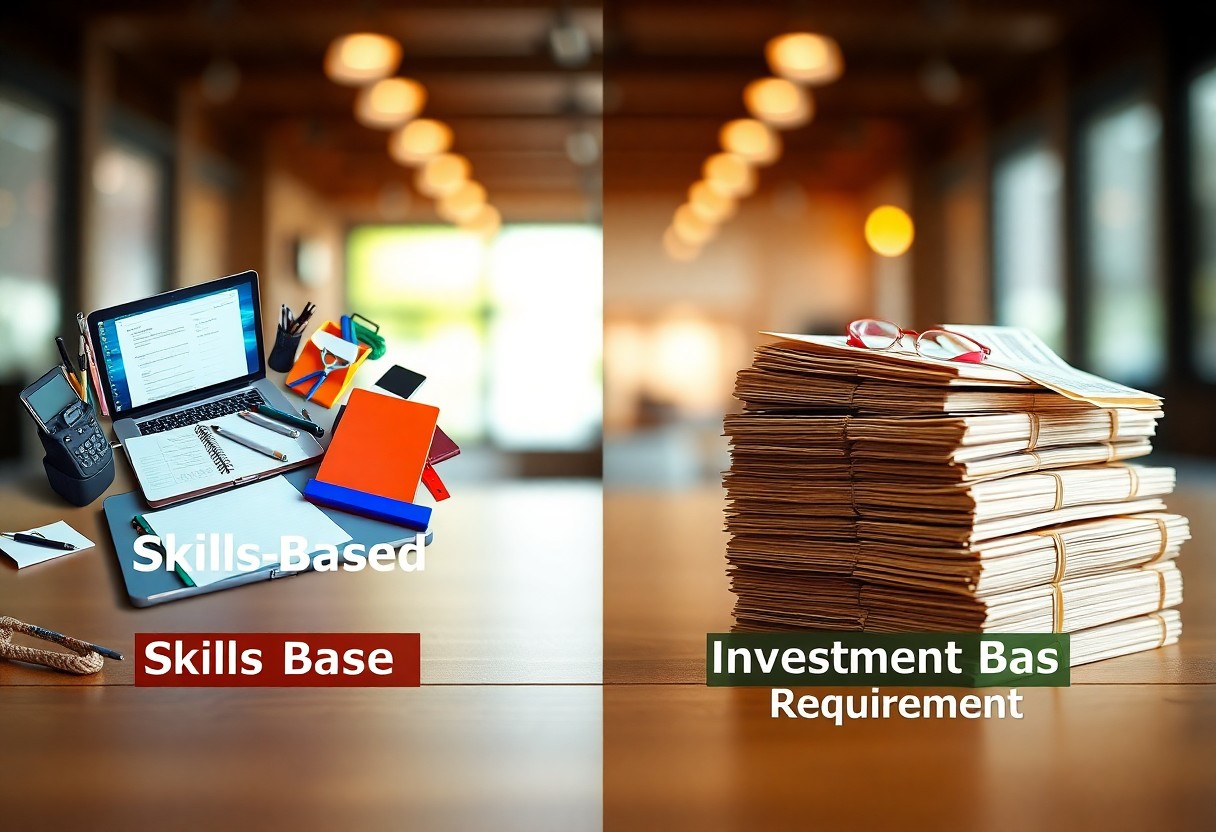
The Skill Set Spectrum: What Entrepreneurs Need
Entrepreneurs must navigate a diverse skill set spectrum to succeed, balancing technical abilities with soft skills. Your proficiency in areas such as problem-solving, communication, and leadership significantly influences your startup’s trajectory. Being adaptable and continuously improving your skill set allows you to respond to market changes and emerging opportunities effectively. Knowing which skills to prioritize based on your startup’s focus—whether it’s product development or market strategy—will determine your path to growth and longevity in the competitive landscape.
Essential Skills for Skills-Based Startups
If you lean towards a skills-based startup, your focus should be on hands-on competencies such as coding, design, or marketing. Mastering these skills allows you to create and refine your product without heavy reliance on external resources. Being proficient in these areas not only boosts your confidence but also gives you a competitive edge, enabling you to pivot your strategies based on real-time feedback and customer needs.
The Toolset for Investment-Driven Ventures
In investment-driven ventures, your toolset involves leveraging financial acumen and market analysis tools. Knowledge of venture capital trends, fundraising strategies, and pitch development becomes necessary to attract investors and secure funding. You should be familiar with platforms such as AngelList for connecting with investors, and tools like Crunchbase to research market competition and opportunities.
Understanding different funding stages—seed, Series A, and beyond—will guide your growth strategy effectively. Using financial modeling software helps you project revenues and expenses, providing a clear roadmap to potential investors. Familiarity with pitch decks and investor relations enhances your ability to communicate your startup’s vision persuasively. The right tools not only facilitate fundraising but also shape your operational strategies, enabling you to scale effectively while maintaining investor confidence in your business model.
The Financial Landscape: Risks and Returns
In navigating the financial landscape of startups, understanding the balance of risks and returns is imperative. Skills-based models often emphasize leveraging your expertise and abilities, which can yield high rewards with lower capital outlay. In contrast, investment-based frameworks may require significant upfront funding, leading to varied financial risks depending on market conditions and the viability of the business idea. Your approach will significantly influence not only potential profitability but also the paths available for growth and sustainability.
Evaluating the Risk Profiles of Skills-Based Models
Risk in skills-based models often stems from reliance on personal competencies and market adaptability. With lesser financial investment, your primary concern shifts to operational execution and the ability to pivot based on market feedback. However, if you lack the requisite skills or face unforeseen challenges, the risk of failure escalates quickly. It’s imperative to honestly assess your capabilities and the industry landscape to mitigate potential pitfalls effectively.
Investment Strategies and Their Implications on Growth
Investment strategies dictate not only the flow of capital but also the speed and direction of growth for your startup. A lean investment approach might prioritize imperative developments, ensuring sustainable growth, while aggressive funding could accelerate market entry and expansion. Both strategies carry implications: a cautious strategy may limit immediate growth potential, whereas a high-risk investment could result in disproportionate returns or failures, depending on market reception and execution.
Choosing an investment strategy involves weighing short-term goals against long-term viability. For example, startups like Airbnb secured early investment to fuel rapid expansion, positioning themselves as market leaders. In contrast, other companies opted for bootstrapping, allowing them to retain control and steadily grow at a manageable pace. Assessing your target market, competitive landscape, and operational capacity will guide your investment strategy, ensuring it aligns with your ultimate vision while balancing risk and reward effectively.

Navigating the Learning Curve: Building Competence
Building competence in your chosen field is a continuous journey that requires dedication and adaptability. As you encounter challenges, the way you approach learning can significantly impact your growth trajectory. The divide between skills-based and investment-based learning reveals different pathways towards mastery, with skills-related competencies often offering a more dynamic and hands-on experience. Leveraging your existing strengths while actively seeking new knowledge will allow you to thrive in the evolving startup environment.
Learning Through Practice: The Skills-Based Approach
Emphasizing practice over theory, the skills-based approach enables you to acquire expertise through real-world application. Engaging in projects, internships, or even freelance opportunities allows you to develop practical skills important for your startup journey. This experiential learning enriches your understanding of your industry and hones your problem-solving abilities, making you more adaptable to shifting market demands.
Educational Pathways: Formal Training vs. Self-Initiative
Two primary pathways define how you can acquire the necessary skills: formal training and self-initiative. Formal training often includes structured curriculums in educational institutions, while self-initiative encompasses online courses, workshops, or self-guided study. Each method offers distinct advantages that can cater to your personal learning style and schedule.
Formal training can deliver a comprehensive framework and networking opportunities through programs offered by universities or specialized institutions. Accredited courses often bolster your credibility, attracting investors and partners. On the flip side, self-initiative empowers you to tailor your learning, allowing you to focus on pertinent skills as they arise in your venture. Online platforms such as Coursera or LinkedIn Learning provide vast resources to develop relevant knowledge at your own pace, enabling you to stay ahead in competitive landscapes without the constraints of traditional education. Both paths have successful proponents; consider blending them for a well-rounded approach.
Real-World Impacts: Success Stories and Lessons Learned
Examining real-world examples of skills-based and investment-based startups reveals valuable insights into their trajectories. Entrepreneurs have successfully navigated challenges by leveraging their unique skills, while others have relied heavily on financial backing to scale rapidly. Each approach has shaped the startup landscape, providing lessons on adaptability, resourcefulness, and understanding market demands.
Skills-Based Success: Entrepreneurs Who Found Their Way
Skills-based entrepreneurs often innovate by leveraging their expertise. For instance, consider a software developer who created a successful app, utilizing minimal capital but maximizing unique programming skills. These success stories demonstrate how mastery in a specific field can lead to substantial outcomes without significant financial investment.
Investment-Fueled Triumphs: Case Studies of Financial Backing
Investment-focused startups frequently achieve remarkable growth due to substantial funding rounds. Companies like Uber and Airbnb attracted millions in investments, allowing them to scale quickly, dominate markets, and enhance product development. These case studies illustrate how financial resources can accelerate growth and facilitate rapid market entry.
- Uber: Raised over $25 billion across various funding rounds, achieving a valuation of $82 billion by 2021.
- Airbnb: Secured $6 billion in funding, reaching a valuation of $18 billion ahead of its IPO in 2020.
- DoorDash: Garnered $2.5 billion before going public, achieving a market valuation of $60 billion in December 2020.
Investment-fueled startups showcase how strategic fundraising can lead to swift expansion and market leadership. The aforementioned examples highlight the capability to attain high valuations and significant market share through well-timed financial backing. Analysis of their funding trajectories provides insights into investor expectations and the potential for rapid scalability within competitive landscapes.
- Snap: Raised $3.4 billion in its IPO, achieving a valuation of $24 billion at launch in 2017.
- Peloton: Generated over $994 million during its IPO, reaching a valuation of $8.1 billion.
- WeWork: At its peak, had a valuation of $47 billion after raising over $12 billion from investors.
To wrap up
Summing up, as you evaluate startup capital options, it’s important to understand the distinction between skills-based and investment-based approaches. Skills-based funding relies on your expertise and capabilities to drive growth without substantial financial backing, while investment-based capital emphasizes securing external funds to accelerate your startup. Assess your strengths, resources, and long-term goals to determine which method aligns best with your vision. This informed decision will ultimately guide the development of your venture and its sustainability in the competitive market landscape.
FAQ
Q: What is the primary difference between skills-based and investment-based startup capital?
A: Skills-based startup capital relies on the entrepreneur’s abilities, knowledge, and experiences to create value, while investment-based capital involves seeking external funding to finance the startup’s operations and growth.
Q: How do learning requirements differ between skills-based and investment-based approaches?
A: Skills-based approaches necessitate acquiring specific skills related to product development, marketing, and management, while investment-based approaches often emphasize financial literacy, fundraising techniques, and investor relations.
Q: What are the advantages of a skills-based approach to startup capital?
A: Advantages include lower initial costs, reduced dependency on external funding, and the potential for greater personal growth as founders develop diverse competencies relevant to their business.
Q: In what situations is investment-based startup capital more advantageous?
A: Investment-based capital is advantageous when rapid scaling is necessary, when market competition is fierce, or when specific expertise is needed that the founder does not possess.
Q: How do these two approaches impact the sustainability of a startup?
A: Skills-based startups may have a stronger foundation through self-sufficiency, fostering resilience, while investment-based startups can accelerate growth and innovation but may face pressure to perform quickly and efficiently to satisfy investors.
Author

The Nerd Reich: Silicon Valley Fascism and the War on Democracy
$30.00 (as of September 19, 2026 07:39 GMT +00:00 – More infoProduct prices and availability are accurate as of the date/time indicated and are subject to change. Any price and availability information displayed on [relevant Amazon Site(s), as applicable] at the time of purchase will apply to the purchase of this product.)
The Altar of Pergamon: The Mystery of the Dark Angel and the Future of the World
$21.48 (as of September 19, 2026 07:39 GMT +00:00 – More infoProduct prices and availability are accurate as of the date/time indicated and are subject to change. Any price and availability information displayed on [relevant Amazon Site(s), as applicable] at the time of purchase will apply to the purchase of this product.)
The Unselected Journals of Emma M. Lion: Vol. 9
$21.00 (as of September 19, 2026 07:39 GMT +00:00 – More infoProduct prices and availability are accurate as of the date/time indicated and are subject to change. Any price and availability information displayed on [relevant Amazon Site(s), as applicable] at the time of purchase will apply to the purchase of this product.)
Theo of Golden: A Novel
$13.98 (as of September 19, 2026 07:39 GMT +00:00 – More infoProduct prices and availability are accurate as of the date/time indicated and are subject to change. Any price and availability information displayed on [relevant Amazon Site(s), as applicable] at the time of purchase will apply to the purchase of this product.)
Lost in Space: 5,000 Facts for Navigating the Universe
$35.00 (as of September 19, 2026 07:39 GMT +00:00 – More infoProduct prices and availability are accurate as of the date/time indicated and are subject to change. Any price and availability information displayed on [relevant Amazon Site(s), as applicable] at the time of purchase will apply to the purchase of this product.)
World of Eric Carle, Around the Farm 30-Button Animal Sound Book – Great for First Words – PI Kids
$3.46 (as of September 19, 2026 07:39 GMT +00:00 – More infoProduct prices and availability are accurate as of the date/time indicated and are subject to change. Any price and availability information displayed on [relevant Amazon Site(s), as applicable] at the time of purchase will apply to the purchase of this product.)
One Man In: The Explosive Firsthand Account of the Lone Special-Ops Commando Who Fought Off a Major Terrorist Attack in Kenya
$30.00 (as of September 19, 2026 07:39 GMT +00:00 – More infoProduct prices and availability are accurate as of the date/time indicated and are subject to change. Any price and availability information displayed on [relevant Amazon Site(s), as applicable] at the time of purchase will apply to the purchase of this product.)
Whistler: A Novel
$14.99 (as of September 19, 2026 07:39 GMT +00:00 – More infoProduct prices and availability are accurate as of the date/time indicated and are subject to change. Any price and availability information displayed on [relevant Amazon Site(s), as applicable] at the time of purchase will apply to the purchase of this product.)
The Altar of Pergamon: The Mystery of the Dark Angel and the Future of the World
$21.48 (as of September 19, 2026 07:39 GMT +00:00 – More infoProduct prices and availability are accurate as of the date/time indicated and are subject to change. Any price and availability information displayed on [relevant Amazon Site(s), as applicable] at the time of purchase will apply to the purchase of this product.)




Leave a Reply